Better Winter Hay Storage: Equipment Solutions for West Tennessee Farms
12/15/2025

After the fall hay harvest season, winter quickly approaches. For most farmers and property owners, the goal after the initial harvest and baling cycle is to store the hay bales away for use at a later date. When you’re working with hay, it’s important to keep the product as dry as possible and away from environmental factors that could dampen or ruin the product. And for that, you need the proper equipment to protect your precious hay bales from the damaging elements. Let’s take a look at a few machines, attachments, and storage solutions that will keep your hay dry all winter.
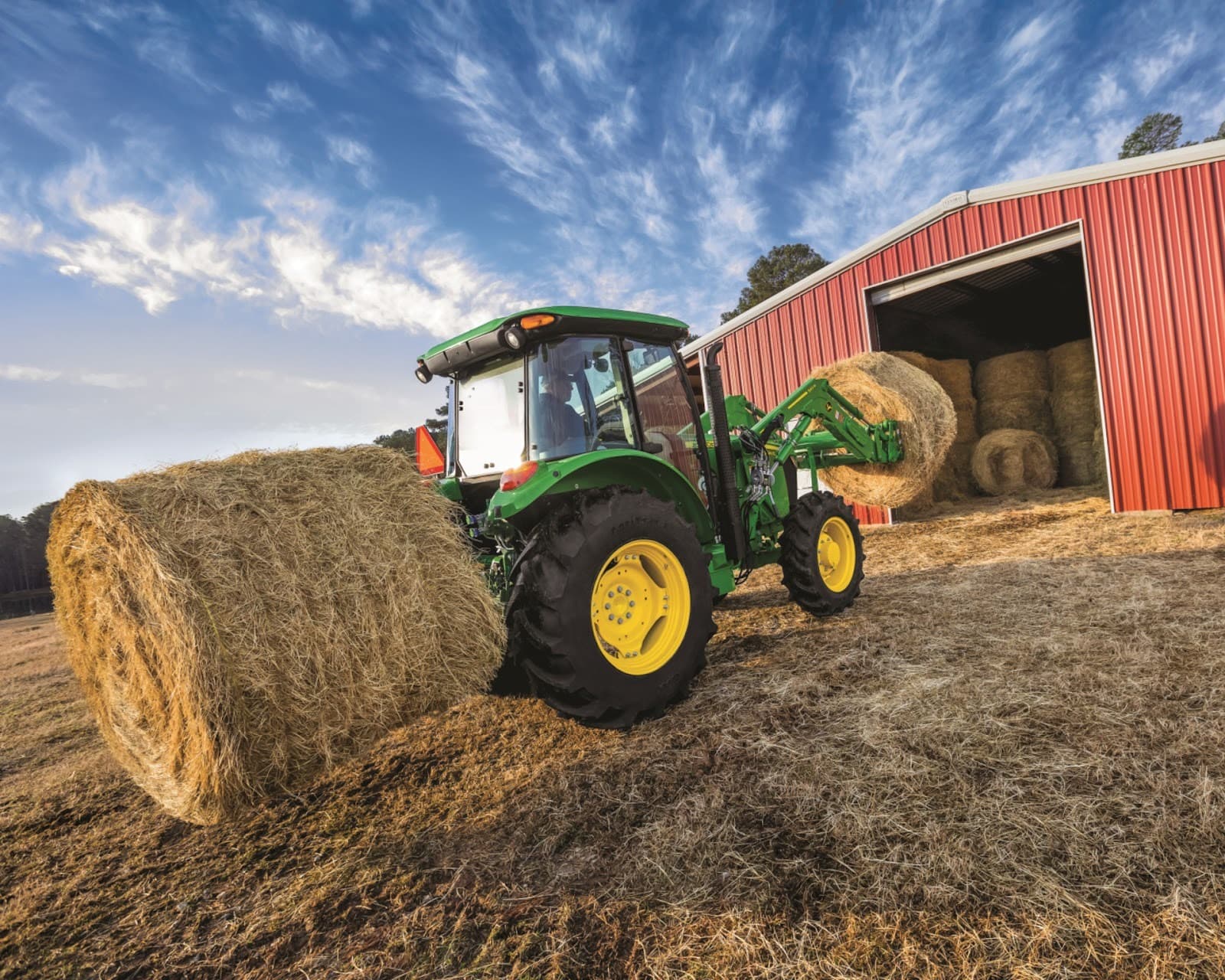
One of the most essential aspects of hay bale storage is getting it from your field to your storage area. The best and most efficient way to move it is with a compact tractor outfitted with a bale spear. This attachment is especially useful for moving large round bales that can exceed 1,000 pounds or more, a weight that would be impossible for the average worker to move. Compact tractors in the John Deere 3, 4, and 5 Series are perfect for moving large round hay bales with a Frontier 3-Point Bale Spear. For most applications, a tractor with a horsepower rating of 25 or more is ideal, with 40 or more recommended for the largest and heaviest round bales. Most John Deere tractors in the 3, 4, and 5 Series easily fit this qualification.
Sometimes, a bale spear won’t cut it, especially when you’re dealing with small bales that aren’t as easily moved with larger attachments. That’s when a compact tractor with a front-end loader comes into play. Front-end loaders allow you to easily lift and move heavy loads, perfect for stacks of small square or rectangular hay bales that are too small for a bale spear to pierce. Front-end loaders are compatible with most John Deere compact tractor models; however, please verify that the front-end loader model is compatible with your specific machine.
Did you know that ground moisture accounts for about 50% of overall hay loss outdoors? Ground moisture can be a killer for your hay usage and profitability! Before storing your hay away, you should consider prepping the site to ensure your bales have the best environment possible and prevent excess moisture from seeping in. A box blade is a great attachment that can be used to create a level, and well-draining storage area with a proper slope, so even if you have to store on the ground, water won’t pool up from heavy rains or snow melt.
You’ve got your tractor, you’ve got the proper attachments; so now it’s time to consider the site where you’ll be storing your hay bales over the winter season. Covered structures, like a shed or a barn, are the best place to store hay because they stay dry and away from the elements that can dampen your bales, like rain or snow. Pole barns or dedicated feed rooms are the best option for keeping hay dry, but cheap options include any fabric-covered building or tent structure that can withstand the winter. You can speak with our team, and we can recommend proven solutions for keeping your hay dry.
After you’ve prepped your site and selected the structure where you’re going to store your hay bales, you should also consider how to keep your hay bales elevated, protected, and properly covered. Pallets, old tires, or a simple gravel base are great ways to keep your hay from touching the soil and prevent moisture and mold from building up underneath the bales. You can also consider heavy rubber pads, like those used in horse stalls, to keep the bales from touching dirt. Keeping bales off the ground can reduce storage loss by up to 5% compared to those stored directly on the ground.
If you’re looking for a compact tractor, bale spear, front-end loader attachment, or even an expert to give you advice on the best hay bale storage techniques, you can find it all at Tennessee Tractor. We have locations all over West Tennessee, and we’re ready to help you keep your bales dry and at their peak quality all winter long.
Come visit us today, or call us anytime. We are happy to help.