Skid Steer Attachments that Earn Their Keep on a West Tennessee Farm
10/14/2026

A skid steer that only does one job is not a very useful machine. On a West Tennessee farm where you’re juggling multiple jobs at a time, that's not good enough. Between row crops, hay, and cattle, the work changes with the season, and the equipment needs to keep up. That's where skid steer attachments come in. A skid steer is really just a power source; it’s the attachment that decides what it does that day.
Tennessee Tractor has served West Tennessee for decades, with locations in Alamo, Brownsville, Dyersburg, Jackson, Martin, Paris, Ripley, Somerville, Trenton, and Union City. Here's a look at the attachments that make a skid steer worth its space in the equipment shed, plus a few more worth considering for your operation.
A skid steer earns its keep because it's compact enough for tight barn lots and gates, but strong enough for real farm work. Tennessee Tractor carries John Deere skid steer models built for exactly that range, from the entry-level 316GR up through the 330G, which is rated for an operating capacity of 3,000 pounds. With over 100 John Deere attachment options built for these machines, the model you choose mostly comes down to how much weight and horsepower your heaviest jobs need.
Pallet forks are the attachment most farms use every single week. They move feed sacks, fence posts, seed pallets, and mineral tubs from the truck to the barn without another set of hands. If you only add one attachment to a skid steer, make it a fork attachment.
Hay doesn't move itself, and a bale spear is built for that job alone. The spear punctures round bales for a secure lift. A low-profile design keeps your view of the yard open while you're moving through gates and around cattle. For farms feeding through the winter, this attachment pays for itself by January.
Fence lines, ditch banks, and pasture edges need cutting back before they take over. A rotary cutter turns that chore into a quick pass instead of an afternoon with a brush hog. It leaves a clean cut behind it, too. Unlike rotary cutter attachments on compact tractors, most skid steer rotary cutters attach to the front of the machine rather than the back. This gives you more control over the rotary cutter using the skid steer's hydraulic arms rather than pulling it behind a tractor.
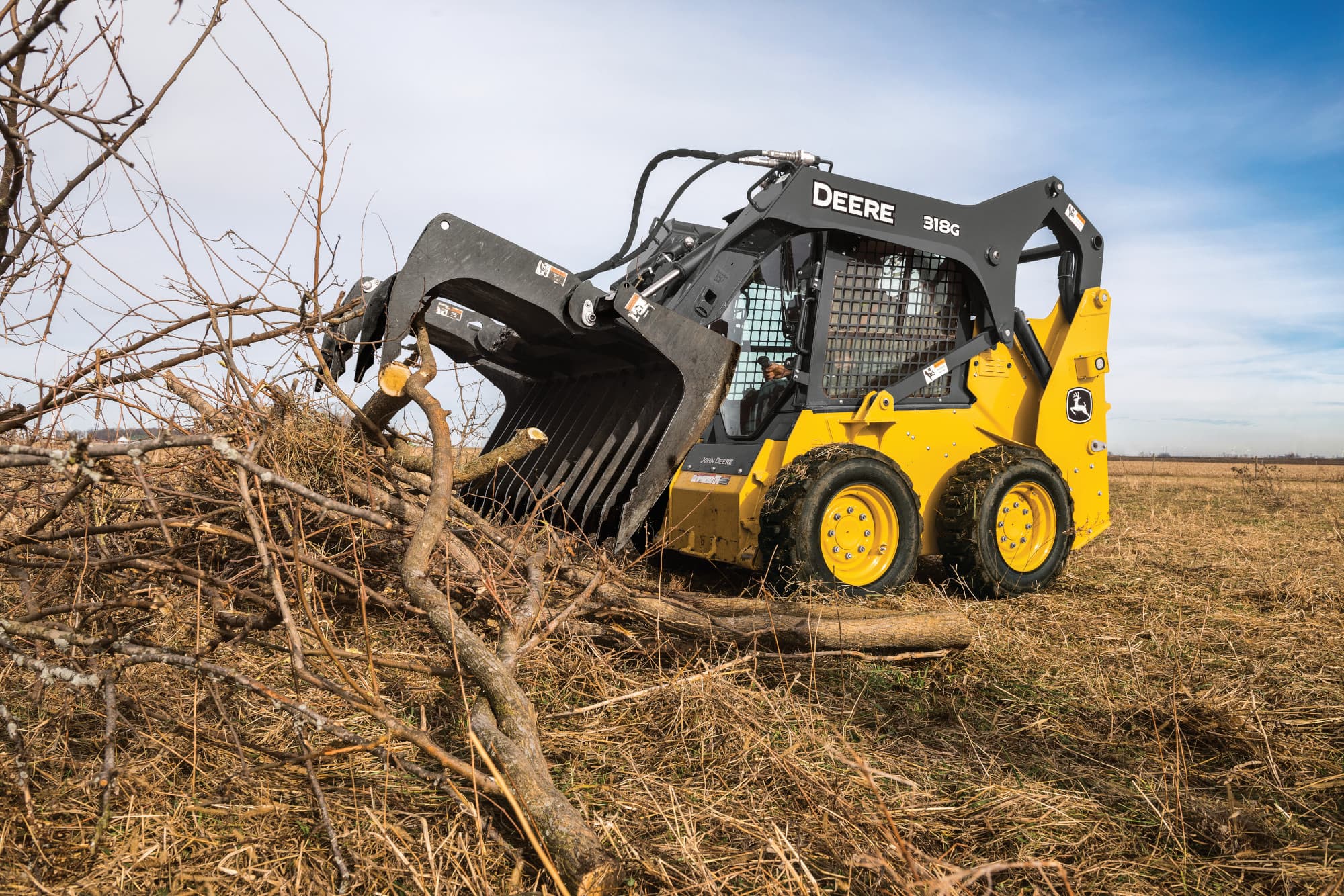
Clearing brush, fallen limbs, and field rock is a different job than loading dirt, and a rock grapple is built for it. The claw-style jaws grip odd-shaped material that would slide right out of a bucket. That makes cleanup after storms or land clearing faster and safer.
A bucket is the attachment most farms already own, and for good reason. A rollout bucket lifts and dumps loose material like dirt or gravel at height. A side-discharge bucket spreads mulch, straw, or soil in tight spaces like a barn aisle or a trench. Between the two, most daily loading jobs are covered.
Livestock operations know this chore well. A scraper with rubber cutting edges clears mud and manure off hard surfaces faster than a shovel, and it does a more thorough job. That matters for keeping lots and walkways usable through a wet West Tennessee winter.
Quick Reference: Which Attachment for Which Job
| Attachment | Best For | When It Shines |
|---|---|---|
| Pallet Forks | Moving feed, fencing, and supplies | Year-round |
| Bale Spear | Handling and feeding round bales | Fall through winter |
| Rotary Cutter | Clearing brush and pasture edges | Spring and summer |
| Rock Grapple | Storm cleanup and land clearing | Year-round, as needed |
| Rollout/Side-Discharge Bucket | Everyday loading and spreading | Year-round |
| Scraper | Clearing mud and manure from lots | Wet winter months |
These six skid steer attachments cover most of what a working farm needs day to day, but they're not the whole list. A mulcher turns underbrush into ground cover that helps hold soil moisture and slow erosion, which is worth a look if you're reclaiming overgrown ground. A power rake preps a seedbed or grades soil before planting. Augers make quick work of post holes for fence lines. For the full rundown of implement options built for West Tennessee farms, see our guide to John Deere skid steer implements.
Whether you're running a 316GR around the barn lot or a 330G across the back forty, the right attachments turn one machine into a half-dozen tools. Find your nearest Tennessee Tractor location or contact us to talk through which attachments make sense for your operation.
Always review attachment weight, hydraulic flow, and safe operating practices with your dealer. Tennessee Tractor is here to help.
Most John Deere attachments use a common quick-attach system, but hydraulic flow and lift capacity still need to match the machine. Tennessee Tractor's team can confirm which attachments fit your specific model before you buy.
On most models, yes, with a manual pin-and-latch process. The 330G offers an optional electrically actuated Quik-Tatch system that lets you connect some attachments from inside the cab. That saves time when you're swapping tools several times a day.
Pallet forks or a bucket. Both handle the widest range of everyday tasks, which makes either one the attachment that earns its keep fastest.