How a Backhoe Attachment Pays for Itself on a West Tennessee Farm
11/10/2026

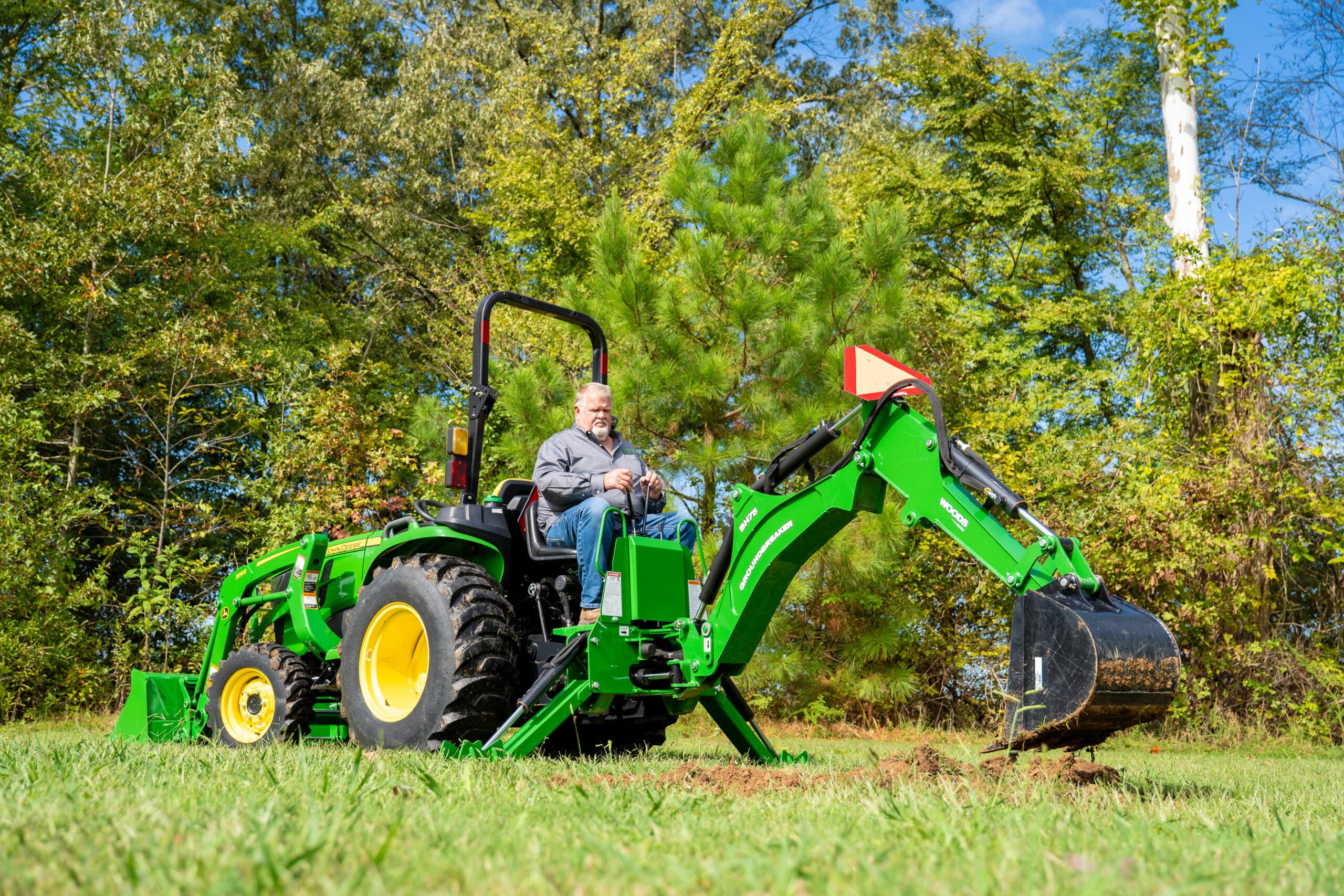
Have you ever considered a backhoe attachment for your tractor? A backhoe attachment pays for itself by replacing the jobs you currently rent a machine for or hire out. On a West Tennessee row-crop farm, that means ditch cleanout, waterline repair, culvert work, stump and post removal, and storm cleanup. Instead of waiting on a contractor, you dig the day the ground is right.
Let’s take a closer look at why a backhoe attachment is a great investment that pays dividends quickly on your property.
A backhoe attachment mounts to the rear of your tractor and digs with a hydraulic boom, dipperstick, and bucket. You sit in a seat on the attachment, drop the stabilizers, and get to work. The loader stays on the front, so you can dig a trench and move the dirt without switching machines.
Most farm digging jobs are small. They are two hours of work, surrounded by a half day of hauling a machine to the field and back. But all of that changes with a backhoe attachment on your tractor.
The jobs that pay the fastest are the ones that you keep coming back to do. For many West Tennessee farmers, the usual list looks like this:
None of those are big enough to justify a dedicated machine. Together, they are more than enough to justify an attachment for your tractor.
Think of the payback as the hours you stop renting or hiring, plus the hours you’ll save by having the attachment easily available.
Start by listing every digging job you paid for or rented a machine for over the last three years. Add in the ones you put off because getting equipment there was a hassle. Price those out at what you actually paid. Then compare that to a quote from your dealer.
Most farms are surprised by the savings. The paid jobs add up faster than they remember. And the put-off jobs, the ditch that never got cleaned or the drain that never got dug back, are often costing more in lost yearly yield than the attachment would have.
Be sure to put real numbers to your situation before you buy. We will quote the attachment and help you understand how much it can save you in yearly costs.
We carry seven John Deere backhoes for compact and utility tractors:
The right one depends on your tractor’s capabilities. For example, the 370B is the correct backhoe for the 3E Series compact tractors, including the 3025E and 3038E. To find the right backhoe attachment for your model, bring us your tractor or tell us over the phone, and we will confirm the fit before you order anything.
Features vary across the line. The 370B puts the stabilizers, boom, and swing locks within reach of the operator's seat. The 485A moves the controls onto the tower for easier access, and its curved power boom gives you a better view. The 595 offers a full 180-degree swing and Quik-Tatch mounting.
You need a tractor that the backhoe is approved for, with the hydraulic capacity to run it and enough weight to stay planted.
Our compact and utility lineup runs from the 1 Series up through the 5 and 6 Series, including the 1023E, 1025R, 2025R, 2038R, 3025E, 3038E, 4066R, and 5105M. A loader on the front is required on some models, like the 3E, as it helps to stabilize the tractor and diversify what your tractor is capable of after the dig is over, like moving dirt elsewhere. The 120E loader is compatible with the 1023E and 1025R; the 120R fits the 1023E, 1025R, and 2025R.
Ballast matters, too. A backhoe changes how the tractor sits and how it handles with a loaded loader bucket. Follow John Deere's ballasting guidance for your tractor and loader rather than guessing, and ask our service team if you are unsure.
Check four things: fit, hydraulics, mounting, and how often you will really use it.
Bring us your tractor model and a short list of the digging jobs you keep putting off. We will tell you which backhoe fits, what it costs, and whether the math works for your place.
Stop by any of our 10 Tennessee Tractor locations across West Tennessee, or give us a call today.
You can, but most farms do not. The attachment adds length and weight that get in the way during planting and harvest. Many owners run it hard in late winter and after harvest, then pull it off.
For small farm jobs, yes. For all-day production digging, no. An attachment is built for the trench, the culvert, and the stump, not for a construction schedule.
Running an approved John Deere attachment on an approved tractor is the safe path. Talk to our service department before mounting anything that was not built for your machine.
That depends on the model and the mounting system. Ask us to walk you through the swap on the exact combination you are considering before you buy.